Vol. 21 (2025): UNDERWATER FORENSIC ARCHAEOLOGY Principles, methods, contexts
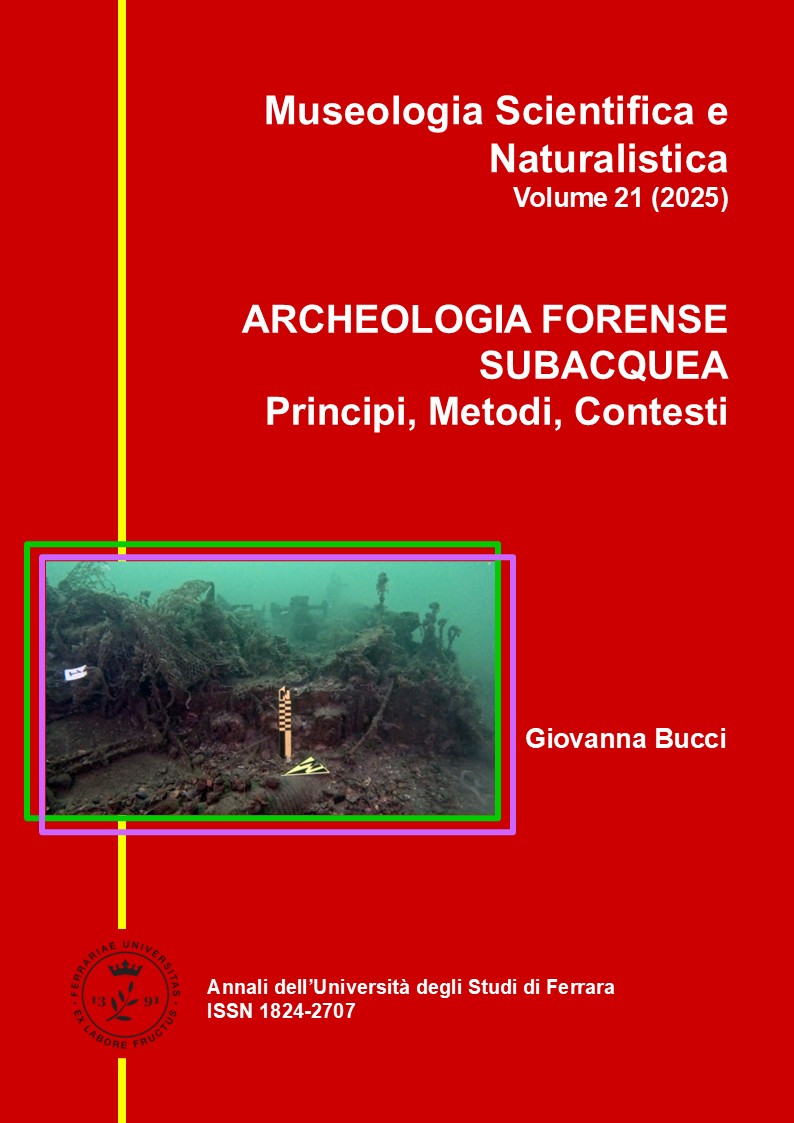
The work provides a comprehensive treatment of a specialized discipline devoted to the investigation of submerged forensic archaeological contexts.
By integrating underwater archaeology, forensic sciences, and technology, the volume places particular emphasis on the evidentiary value of data, the traceability of evidence, and strict adherence to scientific and legal procedures.
Following a theoretical framework of the discipline and its fields of application, the manual examines the nature of underwater forensic sites, highlighting the role of depositional context and environmental factors in the distribution and preservation of material remains. A substantial methodological section is devoted to the principles of traceability and evidentiary proof, site classification, and the analysis of depositional and post-depositional processes. Particular attention is given to the analysis of the physical and structural dynamics involved in the various modes of sinking of vessels and aircraft, which are fundamental to the forensic interpretation of submerged contexts. The handbook further illustrates the planning of forensic archaeological operations and dives, team organization, and the use of remote sensing instruments, alongside direct survey techniques, documentation, and controlled excavation.
The final sections address procedures for screening, conservation, and management of evidence, including guidelines for the recovery of biological materials and the chain of custody. The work is an essential methodological reference for underwater forensic investigations and presents two case studies from the Upper Adriatic Sea.